Sunday, June 16, 2019

Rebirth at the Place of Mormon - Book of Mosiah, Chapter Eighteen (Mosiah 18)

You can read the entire chapter at the following link: https://www.lds.org/scriptures/bofm/mosiah/18?lang=eng

From the grisly death of Abinadi, Mormon’s abridgment quickly turns to Alma, the priest of Noah who was so inspired by Abinadi’s final call to repentance that he courageously stood up to his king and his conspiring colleagues, and then fled from their efforts to capture and kill him.

It’s as if Mormon is having us focus on the transition from death to rebirth, because the story of Alma is about a man and those who follow him starting over from a fallen and corrupt society. The first two verses of this chapter highlight repentance and redemption, which are possible “through the power, and sufferings, and death of Christ, and his resurrection and ascension into heaven.”

Alma is not content simply to survive and elude King Noah. He finds a way to privately teach “as many as would hear his word” (verse 3). To do so, he discovers an untouched wilderness area where the people can teach, learn and worship undetected by the king’s henchmen. The place is called Mormon.

Learning the origins of the word Mormon is a very significant thing. By understanding that Mormon becomes synonymous with a place where the people of Alma start over and find refuge and refreshment, we learn why the prophet Mormon received his name and why calling the entire record of this civilization the Book of Mormon is meaningful. For the whole point of keeping the record is to show to us in our day that rebirth and renewal is possible. We can find a place where we are washed clean of our sins and start over by making a covenant. Thus it is that Mormon becomes a symbol of a place where we can go—metaphorically as well as physically—to gain power over the things of the world that try to drag us down. In that sense, Mormon represents the same thing as Zion—a place for the pure in heart. And so because our narrator is named Mormon and calls this book by that name too, he and the Lord want that name to be burned into our consciousness as something pointing us toward this Zion state of being and mind.

As the chapter continues, we learn that the place of Mormon also has cleansing waters, which deepen the significance of the place as symbolizing rebirth. Knowing this, Alma challenges his people to regard the waters as the focal point for their spiritual cleansing and new beginning. He calls unto them to enter into the covenant of baptism. In encouraging this, Alma provides them with a beautifully inspiring vision of who they can become and what they can do (in verses 8-9):
  • Be called God’s people
  • Bear one another’s burdens
  • Mourn with those that mourn
  • Comfort those that stand in need of comfort
  • Stand as witnesses of God at all times and in all things
  • Be redeemed of God and numbered with those who have eternal life

Alma’s words have become the standard for all who seek to follow the Lord’s way. When missionaries, family members or friends want to communicate what it means to become a disciple of Jesus Christ, they invariably cite the above points, along with the following passage (verse 10):

Now I say unto you, if this be the desire of your hearts, what have you against being baptized in the name of the Lord, as a witness before him that ye have entered into a covenant with him, that ye will serve him and keep his commandments, that he may pour out his Spirit more abundantly upon you?

It is important for us to pause and realize that this scripture is not meant “for other people.” It is meant for us to apply to ourselves. If we desire the things mentioned in the bullets above, is there any reason why we should not be baptized (by someone holding the proper authority from the Lord)? After all, the blessings of the Spirit are more powerful than we can imagine. If we truly take the time to ponder this and really weigh it in the balance, there is only one reasonable response.

Image result for image alma baptizing waters of mormon

Not surprisingly, Alma’s words have a powerful effect on those who gather to learn from him. Mormon tells us that Alma baptizes 204 souls in the waters of Mormon, and they are “filled with the grace of God” (verse 16). Alma then goes about establishing these willing and obedient ones as the Church of Christ (verse 17). The process of establishing the Church echoes the one we read about in Mosiah 1-5 with King Benjamin and his people, even though those events take place about 15-20 years after the account described in this chapter, and in a different place (Zarahemla).

The rest of the chapter gives us insight into how Alma (under the Lord’s inspiration and direction) leads the Church in order for it to help people stay with the covenants they have made (verses 17-29). Alma uses his authority from God to ordain other baptized members as priests who can help him teach the growing Church about the kingdom of God. What do they teach? The words of the prophets, which include the key principles of repentance and faith on the Lord. Apparently, they are careful not to insert their own opinions or speculations into the teaching, but instead emphasize that which they know is accepted doctrine. This is an important point for us when teaching truths to each other in our day as well.

Other core principles of Christ’s true Church come out in these verses. Alma has the Church members observe the Sabbath day and gather together in worship, express gratitude in all things, and practice self-reliance while sharing of their abundance to help the needy.

We also learn that how the Church members interact is equally as important as what they do. Alma commands them “that there should be no contention one with another, but that they should look forward with one eye, having one faith and one baptism, having their hearts knit together in unity and in love one towards another” (verse 21).


Ultimately, the group grows to about 450 in number (verse 35). Most apparently still live in King Noah’s domain, while gathering for purposes of worship and instruction in the land of Mormon. Somewhere along the way, King Noah detects that something is going on, and spies on the group. Unable to understand the people’s pure motives because of his own twisted ones, Noah presumes that their gatherings are aimed at overthrowing him. He sends his army to destroy them (verses 32-33). We don’t know how (did one of the Church members find out or was it a divine messenger?) but the people are apprised of the army’s coming and depart into the wilderness (verse 34). There is no going back now. They have made the break from larger society, and are now fully dependent on each other and the Lord—something that requires great faith. 

Saturday, August 4, 2018

One Prophet (Abinadi) Departs, Another (Alma) Enters - Book of Mosiah, Chapter Seventeen (Mosiah 17)

You can read the entire chapter at the following link: https://www.lds.org/scriptures/bofm/mosiah/17?lang=eng

King Noah’s immediate reaction to Abinadi’s bold testimony before the inquisition of Noah’s priests was to sentence Abinadi to death (verse 1). We have already learned of Noah’s unwillingness to let anyone—even and especially the Lord—question him in his supposedly high station.

This is where the true impact of Abinadi’s words emerges, through the changed heart of Alma, one of Noah’s priests. Alma is a young man who, we are told, believed Abinadi’s words because he recognized that he and his colleagues were in the wrong. It is fascinating to consider how Alma’s change of heart took place. As he sat listening to Abinadi, what made him open up to the message, while everyone else rejected it? Was there a specific point where what Abinadi said struck Alma particularly hard, or did feelings from the Holy Ghost gradually work on him until he realized something had changed within him?

Hearing Alma’s story also gives us a chance to consider what we are doing to prepare ourselves to be ready to accept truth when it comes our way. Perhaps the most tragic thing is to have the truth directly in front of us, but we are too proud or distracted to recognize it is something we desperately need. We turn to other sources, thinking they will give us the happiness that is actually right there for the taking.

Whatever the case, Alma becomes infected with Abinadi’s boldness, and stands up for the prophet. I wonder what went through Abinadi’s mind as, after years of being a solitary and unpopular witness for the truth, he finally sees some evidence that it is not all in vain. Someone is finally responding. And not a moment too soon, with Abinadi’s life hanging in the balance. We learn that Alma pleads with Noah to let Abinadi depart in peace (verse 2).

For the moment, Alma’s effort distracts Noah and the other priests. I imagine that having one of his priests suddenly take the side of his prisoner comes as a pretty big surprise to Noah. Diverting attention away from harming Abinadi buys some time. Interestingly, the account says that Noah causes Alma first to be cast out, and only then to have his servants pursue Alma in an effort to kill him (verse 3). Why didn’t Noah just holler, “Seize him!” right away? Is he so surprised that he is unable to think clearly? Or is it that Noah’s cowardice is such that he would prefer to have this wicked deed he orders take place out of his sight? There are so many psychological implications to this scene.

Alma eludes King Noah’s servants, we find, and considers the words of Abinadi to be of such importance that he focuses his efforts on recording them while they are fresh in his mind (verse 4), even though we might think that at a time where Alma’s own survival is at stake, he would focus more on staying out of danger.

We learn that, at the very least, Alma’s intervention has delayed Noah from ordering Abinadi’s immediate execution.  Instead, Noah, whose head is likely spinning at this point, has his guards take Abinadi back to prison, and then spends three days discussing the matter with his remaining priests. This gives Noah and his priests time to rationalize away the nagging feelings they have that maybe there was something to what Abinadi said—especially if it would cause Alma, one of their own, to risk his own life to defend Abinadi.

And rationalize they do. The solution to their problem, they conclude, is to rid themselves as quickly as possible from the source of their guilt. Pin an accusation of blasphemy on Abinadi. In their warped world, they single out for ridicule Abinadi’s prophecy that God would come among us as a man, even though we know this to be a core part of Jesus’ mission.

They leave Abinadi with one chance to save himself. Recant. Take back all he has said in criticism of Noah and his people. Of course, for a prophet who is loyal to the God’s truth first, this is impossible, and Abinadi clearly indicates to Noah and the priests that he is resigned to a martyr’s fate. He makes sure they realize that if they go through with this, the eternal consequence is far more harmful to them than it is to him, as it will “stand as a testimony against you at the last day” (verse 10).

Abinadi’s words and the Spirit that accompanies them are so powerful that Noah once again questions himself. He is about to release Abinadi out of fear—which appears to be well founded—that if he doesn’t, he will face judgment from God. But because Noah is motivated by fear and not by a true change of heart, he lacks constancy. Knowing this, his priests play on Noah’s pride and vanity by reminding Noah that Abinadi has reviled him. And so Noah, revealed as a weak-willed tyrant whose lack of character subjects him to emotional domination by others, orders Abinadi to be killed.

With the final order given, Abinadi suffers one of the worst deaths imaginable, by fire. The savagery and injustice of his treatment leads Abinadi to utter a final prophecy from the flames. He tells his tormentors that their descendants will cause death by fire to many others who believe in the salvation of God. What a sad thing to pass on as a family legacy! And just before Abinadi’s life gives out, he promises those who have passed sentence upon him that they will be hunted, smitten, afflicted with diseases, and ultimately burned to death as he has been.


Wednesday, July 4, 2018

Abinadi: To Be Lost Vs. Staying Lost - Book of Mosiah, Chapter Sixteen (Mosiah 16)

You can access the entire chapter at the following link: https://www.lds.org/scriptures/bofm/mosiah/16?lang=eng

One of the defining characteristics of the prophets of the Book of Mormon is that they testify to their audiences (those they are speaking to in their day and age, as well as us, whom they anticipate through the record they keep) of an opportunity to stand before the Lord, give an account of who we have been and have become, and receive judgment. We see this from Lehi, Nephi, Jacob, Alma and Mormon. And here we see it from Abinadi.

In previous chapters, Abinadi the prophet, who is standing before an inquisition of the wicked King Noah and Noah’s corrupt priests, shared marvelous truths about the Lord’s plan of salvation. At its core, the plan is about and is put into effect by the love that Jesus Christ has for us, a love that is so powerful that it will give Him (because Abinadi is speaking about 150 years before Christ’s mortal birth) power to carry out His matchless ministry, divine sacrifice, and Resurrection.

Now it is time for Abinadi to make sure that Noah and his priests understand that all people, including themselves, will one day recognize and confess before God that Jesus’ mission and accomplishments are real and that the judgment they receive is just (verse 1). And Abinadi doesn’t lead off by describing the great pleasure of those who follow the Lord. He emphasizes the pain that those who reject the Lord’s word will feel at that day (verses 2-3). It must have been pretty obvious to Abinadi’s immediate audience that he was not preaching in the abstract, but was speaking mostly about them.

Abinadi uses words like “carnal” and “devilish” to describe those who have turned away from God’s teachings, but the most important word he uses is probably “lost.” He makes a point to say that redemption through Christ makes it possible for those who are lost not to be endlessly lost (verse 4). But then Abinadi emphasizes that to access Christ’s redemption, those who are lost cannot persist in evil doings (verse 5).

Abinadi is telling his accusers that the inquisition they have convened in an attempt to judge him pales in comparison to the importance and lasting impact of the hearing they all will receive before the Lord. And he tries desperately to bring to life through his words the unavoidable nature of this judgment (verses 10-11). And the hope of eternal happiness that can be theirs through Christ—He who is the endless light and life of the world, who takes away the victory of the grave and the sting of death (verses 7-9).

Abinadi’s final warning to King Noah and Noah’s priests starts in a third person voice that his audience could rationalize as being intended for other people: “The arms of mercy were extended towards them, and they would not; they being warned of their iniquities and yet they would not depart from them; and they were commanded to repent and yet they would not repent” (verse 12). But then he shifts to the unmistakable second person plural (“ye”): “And now, ought ye not to tremble and repent of your sins, and remember that only in and through Christ ye can be saved?” (verse 13)

He leaves them with no doubt of his meaning. The effort of Noah and his priests to separate the law they inherited in the record brought by their ancestors to the New World—the law of Moses—from the plan of salvation represented in Jesus Christ is a completely futile one (verse 14). And no matter the outcome of the tribunal convened to silence God’s prophet in this world, in the world after this one Christ will represent the Father in meting out justice to everyone based on conditions of their repentance (verse 15). And that will be the judgment that really counts. 

Wednesday, June 27, 2018

Abinadi: Prioritizing the Eternal over the Temporal - Book of Mosiah, Chapter Fifteen (Mosiah 15)

You can access the entire chapter at the following link: https://www.churchofjesuschrist.org/study/scriptures/bofm/mosiah/15?lang=eng

In the last chapter, Abinadi used the words of Isaiah to remind Noah and his priests that righteous messengers of God with power to help save people from their sins often aren’t physically appealing, nor do they use flattering words of false praise when they speak to the people. Whether the righteous messengers are prophets or the Savior Jesus Christ Himself, they come in all shapes, sizes and appearances, and they share the truth because they want people to be able to prepare themselves to meet God while there is still time in mortal life.

In this chapter, Abinadi builds on the previous chapter by focusing on (1) the power of Jesus Christ to save, (2) the superiority of truth over flattery, and (3) the real consequences Noah, his priests and all of us face from whether we accept or reject Jesus and His teachings. In doing so, Abinadi puts the finishing touches on the stinging rebuke he has for those of Noah’s priests who claimed that his words were not the “good tidings” Isaiah spoke of. In fact, Abinadi shows that the tidings he brings are the best there could possibly be because they provide real opportunity for change (repentance) before it’s too late.

In doing so, Abinadi powerfully relates who Jesus is and what He will do. Through His willing, sinless sacrifice, and the fact that He is the physically begotten Son of the Father, Jesus will become so united with the Father that they will be indistinguishable. In fact, Jesus is so devoted to His Father and so focused on becoming exactly like Him that Jesus will take on the Father’s name and full power and authority (verses 2-9). And that is so significant to us because through Jesus we can then become heirs to all the same promises. As verse 11 says, if we hearken to the words of the prophets who testify of the Savior, we become the literal seed of the Savior. As Jesus assures of our resurrection, we rejoice in the knowledge that following the gospel path leads to eternal life (verses 23-24). Eternal life is more than simply living forever. It is living forever in a fullness of joy, hand in hand with the Father and Son as we learn to feel and practice love as they do, radiating the blessings of that love as widely to others as we can imagine. It is indescribably wonderful. Abinadi wants his audience to understand that eternal consequences of obedience or disobedience to God’s plan ultimately matter far more than whatever they decide to do within their comparatively small circles of earthly power.

Friday, June 15, 2018

Abinadi: Pointing the Way to Christ Through Isaiah - Book of Mosiah, Chapter Fourteen (Mosiah 14)

You can access the entire chapter at the following link: https://www.lds.org/scriptures/bofm/mosiah/14?lang=eng

To add power to his testimony of the coming Messiah, Abinadi—like Nephi and Jacob in earlier parts of the Book of Mormon—quotes the great Old Testament prophet Isaiah (the entirety of Isaiah 53). Abinadi is trying to show his detractors (King Noah and his priests), with no room for doubt, that the covenant they have with the Lord goes far deeper than a set of rules they can twist to rationalize their evil deeds. Ultimately, judgment is the Lord’s, not theirs. 

The covenant is tied to a Savior whose triumph over death and sin will qualify Him to exercise perfect judgment in the case of each man and woman. The Savior will triumph over sin in two ways. First, He never gives in to temptation. This qualifies Him to be able to accomplish the second triumph—to suffer the pain of others’ sins voluntarily so that He can remove the burden that sin places on all other people. But, the burden is only lifted if those people repent and are willing to turn to Him and actually recognize Him as their Savior.

As Isaiah’s prophecy tells us, many (perhaps most) of the people among whom Jesus lived and moved ultimately could not sufficiently humble themselves to appreciate that this person held the key to their redemption and happiness, and that their acceptance of Him was so much more important than obtaining or maintaining any earthly status or possession. The prophecy says that Jesus will be “despised and rejected of men; a man of sorrows, and acquainted with grief; and we hid as it were our faces from him; he was despised, and we esteemed him not” (verse 3).

As part of the Lord’s perfect plan, Jesus didn’t necessarily look the part to our natural eyes. Isaiah says that “he hath no form nor comeliness; and when we shall see him there is no beauty that we should desire him” (verse 2).

There is a clear double meaning here. In addition to testifying of Christ’s coming,  Abinadi (through Isaiah’s words) is giving his captors and tormentors one last chance to realize that they are making the same mistake with him that Christ’s persecutors will make almost 200 years later. Noah and his priests see Abinadi as a troublemaker emerging from the margins of society, with no advantage in his earthly appearance or status to give them pause about treating him so wretchedly. Abinadi, of course, does not pretend to be the Messiah, but his own situation is a “type” or example that does help point to the injustice that Christ will suffer later.

As the prophecy continues, Abinadi (again, through Isaiah’s words) explains why the Father is willing to have His Son sacrificed for others. And this also gives us some insight into the reason for Abinadi’s own sacrifice. In the bigger picture, by allowing Jesus to suffer and die for all by making “intercession for the transgressors,” the Lord’s “righteous servant shall justify many, for he shall bear their iniquities” (verses 11-12). With this perspective, the wicked who subject Jesus (and Abinadi) to an unjust death are souls to be pitied, because they are completely missing that the person who can save them is the very one they are ridiculing and torturing. By the same token, Jesus (and Abinadi) will receive “a portion with the great” because he made “intercession for the transgressors” and he “hath poured out his soul unto death” (verse 12).

Sunday, May 6, 2018

Abinadi Teaches That the Law Points to the Savior - Book of Mosiah, Chapter Thirteen (Mosiah 13)

You can read the entire chapter at the following link: https://www.lds.org/scriptures/bofm/mosiah/13?lang=eng

As we pick up the thread in this chapter, the prophet Abinadi has done something extremely rare. After being taken captive and put under inquisition by a group of the king’s priests who seek to use their worldly positions, learning, and numbers to intimidate him, he has fended off their attacks and put them on the defensive.

The enraged King Noah orders his priests to get rid of Abinadi, because he simply can’t comprehend that someone is able to defy them when everything is set up for them to have the advantage over Abinadi (verse 1). Perhaps the situation is even more galling to King Noah and his priests because they realize—deep down—that Abinadi has the truth on his side, and they fear more than anything having to answer for their own betrayal of the truth.

But God won’t let the priests do anything to Abinadi until he is able to deliver the message he has for them. After all, the priests are the ones who brought Abinadi before them to answer their questions. They had expected that their bullying tactics would work as they presumably had on those in the past who had gotten in the way of their selfish ambitions. But God had other plans.

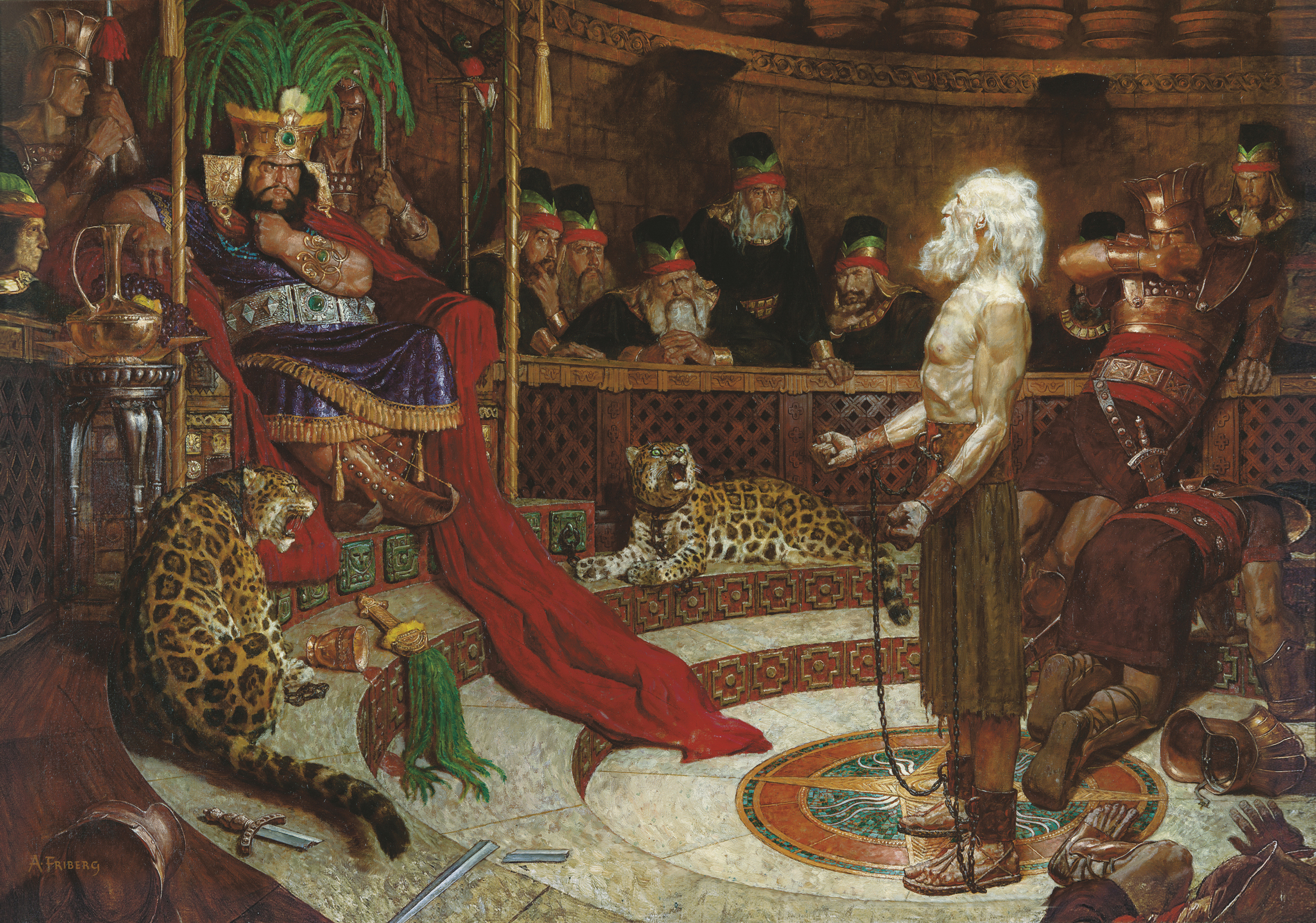
To give Noah and his priests some idea of what they are dealing with, Abinadi’s face shines with a brilliant, heavenly light that approaches the type of luster Moses’ face had when he conversed with the Lord on Mount Sinai as he sought guidance for the Israelites making their way from Egypt to the promised land (verse 5). As scheming and unsavory as they are, these men realize their earthly claims to power are no match for the power and authority that comes from God (verse 6), and our narrator (Mormon) describes the mix of wonder and anger this rouses within them (verse 8).

And it is at this point that Abinadi resumes teaching his detractors about the Ten Commandments. He has already addressed the need to properly worship God, and not to place anything above Him in importance. Abinadi clarifies that part of keeping this commandment is refraining from harm against people who do actually worship God in truth and righteousness (verse 14, which comes straight from the original commandment in Exodus 20:6). The meaning is unmistakable: these men will be rejecting God if they reject Abinadi and other real believers.

After laying out the rest of the commandments in the law of Moses, Abinadi tells Noah and the priests that they have not taught their people how to observe those commandments, because he (Abinadi) has been sent to “prophesy evil” concerning them (verse 26). And furthermore, the law itself is not enough to save the people, because the law’s main purpose is to point them to the Messiah (Jesus) who will atone for their sins. Abinadi shares that Moses and the all the prophets have taught of the Messiah and how His coming would lead to the redemption of those who became His people. However, because the Israelites were “quick to do iniquity, and slow to remember the Lord their God” (verse 29), the commandments were given to them as something that was within their capacity to observe in preparation for the fuller teaching of the doctrine of salvation.

Wednesday, March 7, 2018

Abinadi: The Making of a Prophet - Book of Mosiah, Chapter Twelve (Mosiah 12)

You can read the entire chapter at the following link: https://www.lds.org/scriptures/bofm/mosiah/12?lang=eng  

After being delivered by the Lord from an angry throng of King Noah’s subjects whom he had offended by calling them to repentance, the prophet Abinadi returns two years later and picks up where he left off with the people (verse 1). There’s probably an interesting story behind those two years (Where was Abinadi? What was he doing? Who with?), but it seems as though neither the Lord nor our narrator (Mormon) feels as though these details are necessary for our purposes.

What is important for us to know is that upon his return, Abinadi is even bolder and more unapologetic in his warnings to King Noah’s people than he was in his earlier incarnation. He leaves little to the imagination. Not only does he warn the people that bondage awaits them, but that they shall be driven by men, slain, and their flesh devoured by vultures, dogs, and wild beats (verse 2). This is not going to be pleasant.

Further, Abinadi makes it very clear that King Noah is not exempt from earthly consequences for his and his people’s sins. Abinadi says that Noah’s life shall be valued as a garment in a hot furnace. This points very clearly toward the fiery death Noah will ultimately suffer at the hands of some of his own people.

Apparently, bondage and cruel suffering are not going to be enough to get the people to repent. So Abinadi recites an entire litany of other plagues Noah’s people will be forced to bear, including famine, pestilence, and various natural disasters (verses 4-7)—reminiscent of what the Lord visited upon the Egyptians in Moses’ time. Why does this happen? In verse 8, we learn that part of the reason is to leave a testimony that future generations (us, particularly) can learn from.

This time, it is not Abinadi’s lot to escape capture. The angry mob bind him and bring him before King Noah, reporting on all the heinous things that Abinadi has said will afflict them, and King Noah specifically. We witness here how communities and societies seal their doom by engaging in collective denial about the accountability they face for unrepentantly breaking God’s law. The larger the group of people involved in unrighteousness, the more powerfully the echo chamber of rationalization deludes them into thinking that they are in fact not doing anything wrong, nor will they suffer: “O king, behold, we are guiltless, and thou, O king, hast not sinned; therefore, this man has lied concerning you, and has prophesied in vain” (verse 14). “We shall not come into bondage…and thou shalt also prosper” (verse 15).

The big showdown that Mormon has been setting up between Abinadi and Noah, in his framing of the story, is about to take place. Noah imprisons Abinadi and asks his priests how they should proceed. The priests, likely feeling very confident in their powers of intimidation and argument, essentially say, “Leave him to us…mwah, hah, hah! We’ll get him to break” (verses 17-18).

And so the inquisition begins, much like something out of medieval Spain or England. The participants couldn’t be more different in their morality, approach, or level of understanding.

In the initial round of questioning, the overconfident priests find themselves more than matched by Abinadi’s powers of reasoning and boldness. This astonishes them somewhat (verse 19).


Plan B. One of the priests resorts to the stratagem that the lawyers and scribes would try to use with Jesus during his mortal life. Quote a scripture and ask Abinadi the meaning, in such a way where if he doesn’t give the “right” answer, it will be easy to say that he has blasphemed by going against the prophets. The scripture the priest quotes is from Isaiah: “How beautiful upon the mountains are the feet of him that bringeth good tidings” (verses 21-24).

It’s pretty obvious that the point of this reference is to put Abinadi off balance. The priest lifts the scripture out of context in an effort to create the appearance that Isaiah’s prophecy is about telling people what they want to hear instead of what they need to hear. In essence, the message to Abinadi is, “Isaiah told us that no one likes a killjoy. If you come to us with anything other than flattering words, you must be a false prophet.” And perhaps the priest is also trying in vain to deceive himself, his colleagues, and King Noah into the illusion that their wickedness is not a serious problem.

But Abinadi is ready for the shallow tricks of men. First, he mockingly asks why the priests would ask him to interpret the scripture if they are supposed to be so capable and righteous themselves. Then he differentiates between their cleverness and true wisdom. Wisdom involves applying your “hearts to understanding” (verse 27).

And rather than feeling cowed by the question, Abinadi turns it back on the priests. What do you teach the people? When they say they teach the law of Moses, Abinadi is ready with a zinger of his own: “why do ye not keep it?” (verse 28) He unfolds the truth of the matter, that it is the priests’ leading of the people astray that has caused the Lord to send Abinadi to warn the people (verse 29).

Then Abinadi goes on. We sense that the priests, convicted by their own consciences, are stunned and unprepared for how Abinadi has turned the tables, for he clearly has taken the initiative. He asks them if salvation comes by the law of Moses, and when they say yes, he begins expounding the Ten Commandments, indicating that those who keep the commandments will find salvation (making a very subtle hint that salvation comes not from the law itself, but from the Lord who gives the law). Very simply, he lays out the first two commandments—(1) don’t worship anything above God and (2) don’t create idols (verses 31-36). And then very matter-of-factly states that the priests have not kept either of the commandments. The implication: if you can’t even keep the first two, there’s a very good chance you’re in trouble on the other eight as well.

But he’s also getting ready to explain to the priests that it isn’t the law itself that is the source of salvation, but rather the God who provided the law. The wickedness that Noah and his priests have brought upon their people is like a dark cloud that prevents them from comprehending the plain but essential truth of the gospel—that we need God every step of the way to save us from our sins and help us on the road to becoming like Him.